How to analyze customer reviews with AI
ChatGPT and Claude are good at reading a pile of reviews and naming the themes. They are less good at counting, and they sometimes write quotes nobody wrote. This guide covers the prompts that work and the checks that keep the analysis honest.
Try it freeBy Liran Blumenberg, maker of Comment Downloader. Updated 19 November 2026.
Quick answer
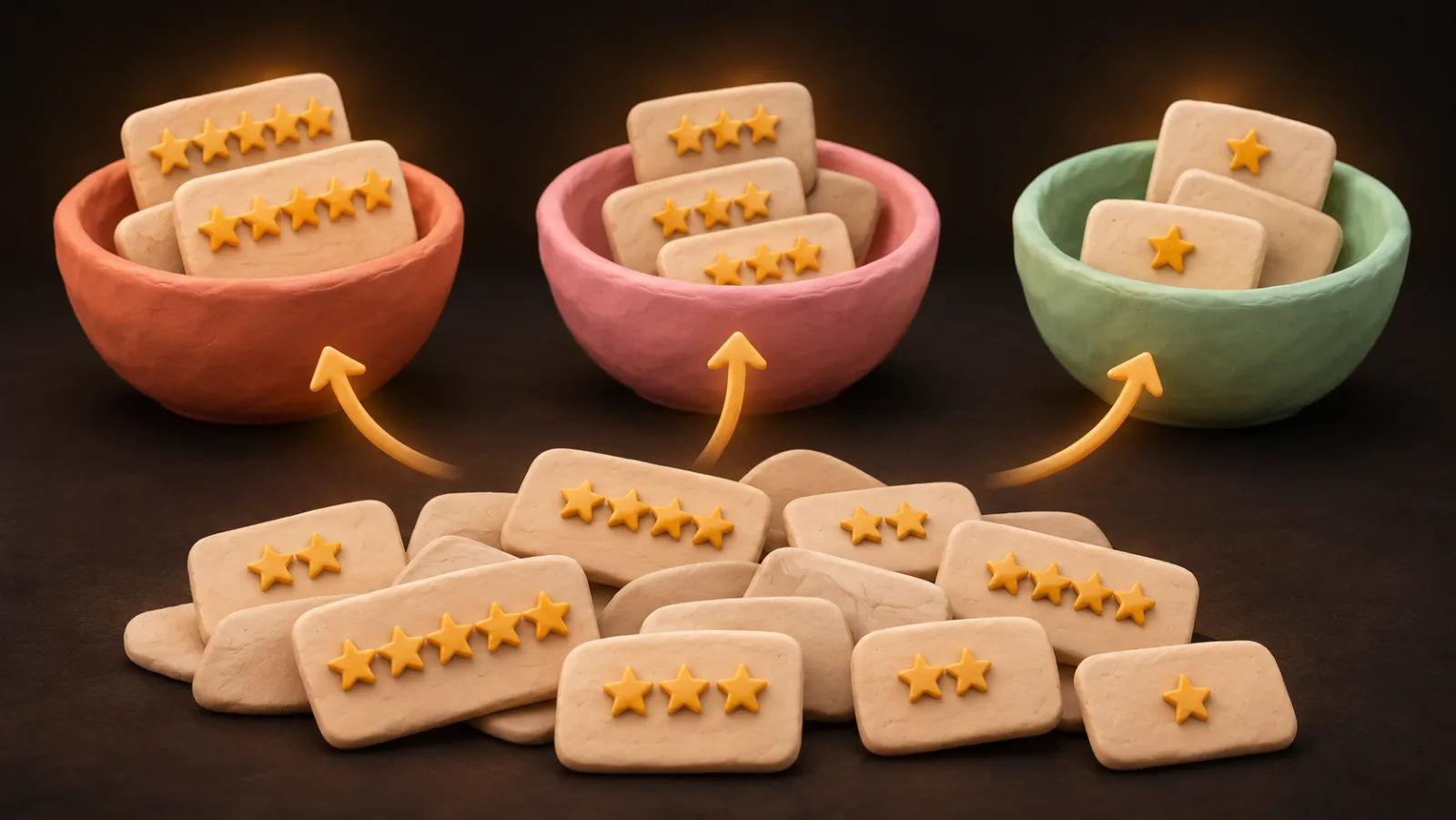
To analyze reviews with AI, export them to a clean file, ask the assistant to tag each review by theme with its row number, then count the themes yourself and check the quotes. Never trust a number or a quote you did not verify.
- Collect the reviews into a CSV (yours and a competitor's).
- Give the assistant the file and a clear set of themes to look for.
- Ask for row numbers with every theme, not just a summary.
- Count and spot-check in the spreadsheet.
Step 1: get the reviews into a clean file
Copying reviews from a product page drops the stars, dates and verified labels, and mixes in page text. An export keeps one review per row.
- Amazon reviews: stars, headline, text, date, verified purchase and helpful votes, up to 100 per run, signed in to Amazon.
- Trustpilot: up to 1,000 per run, up to 200 for each star rating.
- App Store and Google Play: recent reviews with stars and dates, no login.
Comment Downloader exports these to CSV, JSON or Markdown, or as a compact Copy for AI block. Start with the 1 and 2 star reviews of your product and of a competitor. That is where the objections are.
Step 2: prompts that work
Prompts work best when they name the themes you care about and ask for evidence by row. Vague prompts get vague summaries.
| Goal | Prompt |
|---|---|
| Themes | Read every review. List the complaints that appear in more than one review. For each, give the row numbers of the reviews that mention it. |
| Objections | Which reviews mention a reason the buyer almost did not buy, or returned the product? Quote the sentence and give the row. |
| Desires | What result were people hoping for? Use their words, not yours. |
| Competitor gaps | File A is our reviews, file B is a competitor's. Which complaints appear only in B? |
| Ad lines | Write 5 headlines, each based on one complaint above. Under each, cite the rows it comes from. |
Add one rule to every prompt: "Only use the reviews provided. Quote word for word."
Step 3: count and check in the spreadsheet
Let the assistant do the reading and the spreadsheet do the counting. This split keeps the numbers right.
- Add a column called
themeto your CSV. - Ask the assistant for a table of row number and theme, and paste it into that column.
- Make a pivot table, or use
COUNTIF, to count rows per theme. - Sort themes from most to least mentioned.
- Open five random rows per theme and check that they really belong there.
If more than one in five rows is in the wrong theme, tighten the theme names and ask again. Names like "too small" and "runs small after washing" work better than "sizing issues", because the assistant can tell them apart.
Keep the file. When a new batch of reviews arrives, you can tag only the new rows and see whether a theme is growing.
Pitfall 1: quotes nobody wrote

The most common failure is a quote that sounds right but is not in the data. The assistant blends two reviews, shortens a sentence, or writes the review it expects.
How to catch it:
- Ask for the row number or review link with every quote.
- Search three quotes in the CSV with Ctrl+F or Cmd+F. If one is missing, treat the whole answer with care.
- Ask the assistant to mark paraphrases clearly and to keep exact quotes in quotation marks.
This matters most for ads. A headline built on an invented quote is a claim no customer made.
Pitfall 2: counts that are guesses
Language models do not count reliably across hundreds of rows. "About 40 reviews mention sizing" can be 12 or 90.
- Ask for the list of row numbers per theme, then count the list in a spreadsheet.
- Or add a theme column in the sheet and use
COUNTIF. - For single words, paste the text into the free comment word counter. It counts exactly.
Ranking themes by how often they come up is the core of voice of customer analysis, so the counts are worth getting right.
Pitfall 3: the assistant read only part of the file
With a large file, an assistant may read the first part and summarize that, without saying so. Your sample is then whatever came first in the export.
- Ask how many rows it read and to quote the last one.
- Split big files by star rating and analyze each part.
- Sort before you upload so the order is deliberate, for example newest first.
Pitfall 4: a skewed sample
Even a perfect analysis is wrong if the reviews are not the right ones. Three common skews:
- Only five stars. Happy reviews tell you what works, not what stops people buying.
- Only your own product. Competitors' complaints show what buyers still want from the category.
- Only old reviews. A complaint fixed two versions ago will still look big. Check the dates.
Mix reviews with comments from Reddit threads and YouTube videos, where people talk before they buy.
For Amazon in particular, see Amazon review analysis. For support tickets, surveys and NPS answers as well as reviews, see customer feedback analysis.
A faster route with linked quotes
Comment Downloader's report does these steps for you: it ranks pains, objections and desires by mention count and links every finding to the reviews behind it, so each quote can be opened and checked.
Press Find angles on a collection, or Compare to put up to 5 collections in one report. The free plan includes 5 AI reports a month. See a real report to judge the output before you try it. Claim warnings also flag lines, such as health claims, to check before you run them in an ad.
Questions
Can ChatGPT analyze customer reviews?
Yes. It is good at finding themes in reviews you give it. Ask for row numbers with every theme and quote, then count and check them yourself, because counts and quotes are where it makes mistakes.
How many reviews should I analyze?
Enough to see what repeats. A few dozen show anecdotes; a few hundred from your product and a competitor usually show clear patterns.
Why does the AI invent review quotes?
Language models write likely text. When asked for a quote, they can blend or tidy real reviews. Ask for exact quotes with row numbers and search a few in your file.
What is the best prompt to analyze reviews?
Name the themes you want (complaints, objections, desires), ask for row numbers per theme, and add: only use the reviews provided and quote word for word.
Can I analyze Amazon reviews with Claude?
Yes. Export the reviews to CSV and upload or paste them, or connect Comment Downloader so Claude can collect the reviews through your browser and write a report with linked quotes.
Should I use ChatGPT or Claude for review analysis?
Both can find themes in reviews you provide. The bigger difference is the method: give them the full data, ask for row numbers, and count and check in a spreadsheet.